Two managers at a Jaipur software firm. The first one opens every team meeting with targets and deadlines. The second starts with, “What’s blocking you this week?” Guess whose team stays longer, speaks up more and misses fewer deadlines.
That second manager is practising servant leadership, even if nobody calls it that. The idea sounds soft, but it’s been tested in companies for decades. Here’s what it means, the traits behind it, examples worth studying and where it falls short, because it isn’t perfect.
What Is Servant Leadership?
Servant leadership is a leadership style where the leader’s main goal is to serve their team, helping people grow, removing obstacles and building trust, rather than commanding from the top. The leader succeeds when the team succeeds. Robert K. Greenleaf introduced the idea in a 1970 essay called “The Servant as Leader.”
Traditional leadership asks, “How do I get people to do what I need?” Servant leadership asks, “What do my people need so they can do their best work?” Small shift in wording. Big shift in behaviour.
It doesn’t mean being a pushover. A servant leader still sets standards, makes tough calls and holds people accountable. The difference is the motive: the team’s growth, not the leader’s ego.
10 Traits of a Servant Leader
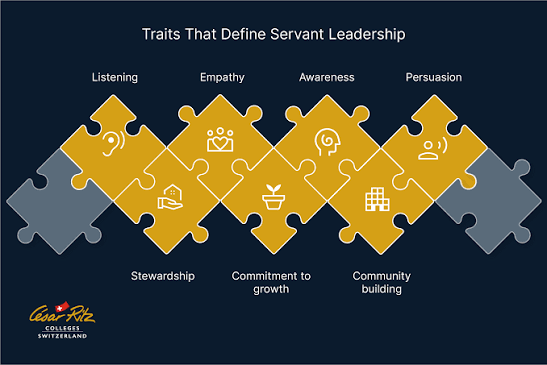
Writer Larry Spears later distilled Greenleaf’s ideas into ten characteristics. Here’s how they show up in real offices:
- Listening. Not waiting for your turn to speak. Actually hearing the problem.
- Empathy. Understanding why someone is struggling, not just noting that they are.
- Healing. Helping people recover after setbacks, layoffs or conflicts.
- Awareness. Knowing your own blind spots, and noticing team mood early.
- Persuasion. Convincing through reasoning, not pressure.
- Conceptualisation. Seeing the bigger picture beyond today’s tasks.
- Foresight. Spotting where decisions lead before they do.
- Stewardship. Treating the organisation as something you’re responsible for, not something you own.
- Commitment to people’s growth. Investing in training, mentoring and promotion.
- Building community. Creating belonging, not just reporting lines.
Nobody has all ten. I’d say pick two you’re weakest at and work on those first.
Servant Leadership vs Traditional Leadership
Servant leadership flips the pyramid. In traditional models, power flows downward from the boss. In servant models, leaders support from the bottom, helping those closest to customers and work make good decisions. Traditional leadership drives compliance, while servant leadership aims for commitment and ownership.
Here’s a quick contrast:
- Decisions: Traditional leaders decide alone. Servant leaders involve the team and explain why.
- Feedback: Traditional leaders judge. Servant leaders coach.
- Success: Traditional leaders count their own wins. Servant leaders count the team’s growth.
- Mistakes: Traditional leaders blame. Servant leaders ask what the system missed.
Honestly, most good managers mix both. The ratio just differs.
Real Examples of Servant Leadership
Gandhi is often cited as a historical model, since he led by living the values he asked of others. In business, the examples are more practical.
Ratan Tata is widely admired in India for how the Tata Group supported staff and families after the 2008 Mumbai attacks, including the Taj Mahal Palace hotel’s employees. Whatever you think of corporate leadership, that response shaped how people talk about him.
Vineet Nayar at HCL Technologies popularised “Employees First, Customers Second,” arguing that engaged employees serve customers better. His book on the idea is worth reading. Internationally, companies like Southwest Airlines and Starbucks are often held up for putting staff welfare first.
I’d be careful with these stories, though. Leaders look good in hindsight. Look at day-to-day behaviour, not headlines.
A Small Business Example
Imagine a Jaipur restaurant owner whose cook keeps arriving late. A traditional boss issues a warning. A servant leader asks why. Turns out the cook’s bus route changed and he’s spending two extra hours commuting.
The owner adjusts shift timings and helps with transport costs. Lateness stops. The cook stays for years and trains two juniors. One conversation saved recruitment, training and morale costs. [link to guide on managing small teams here]
Benefits of Servant Leadership
Teams under servant leaders tend to show higher trust, better retention and stronger collaboration. People speak up earlier, so problems surface before they explode. Learning becomes normal, not scary.
It also helps with hiring. Good people choose workplaces where they’re respected. In tight job markets, that’s a real advantage.
Criticisms and Limits
It isn’t magic.
Decisions can slow down when you consult everyone. In a crisis, such as a fire, a cyberattack or a cash crunch, teams need clear, fast direction. Servant leaders sometimes struggle to be firm, and some people take kindness for weakness.
There’s also a burnout risk. Constantly serving others can drain the leader. And cultural context matters: in strongly hierarchical workplaces, staff may not know how to respond to a boss who asks for their opinions. Start small and be consistent. [link to guide on how to handle office politics here]
How to Practise Servant Leadership This Week
Try these:
- Ask each team member one question: “What would make your work easier?”
- Listen without interrupting for the full conversation
- Give credit publicly and take blame privately
- Delegate a task that helps someone grow, not just one that clears your desk
- Admit your own mistakes openly
Do one for a month. Watch what changes. [link to entrepreneur skills guide here]
FAQs
Who coined the term servant leadership?
Robert K. Greenleaf, in his 1970 essay “The Servant as Leader.”
What are the main characteristics of servant leadership?
Listening, empathy, awareness, foresight, stewardship and commitment to people’s growth are central.
Is servant leadership effective?
Often, especially for retention and trust, but it works best when combined with clear direction and accountability.
What’s the difference between servant and transformational leadership?
Servant leadership centres on serving followers’ needs. Transformational leadership centres on inspiring people towards a shared vision.
Can servant leadership work in Indian workplaces?
Yes, though hierarchy and culture mean you need patience, since employees may take time to trust it.
What are the disadvantages?
Slower decisions, possible burnout and the risk of being seen as soft if standards aren’t clear.
Conclusion
Servant leadership puts the team first, builds trust through listening and measures success by how much people grow. It’s not weakness. It’s a different way to earn authority, and the examples from Tata, HCL and others show why many organisations find it worth trying.
Start tomorrow with one simple question: “What can I do to make your work easier?” Then act on the answer. That single habit does more than any leadership workshop.
Internal linking suggestions:
- [link to guide on managing small teams here], in the small business example section
- [link to guide on how to handle office politics here], in the criticisms section
- [link to entrepreneur skills guide here], in the how-to-practise section
Image alt text suggestions:
- “Manager in a Jaipur office listening to a team member, practising servant leadership”
- “Inverted pyramid diagram comparing servant leadership and traditional leadership”
- “Infographic of 10 servant leadership traits”