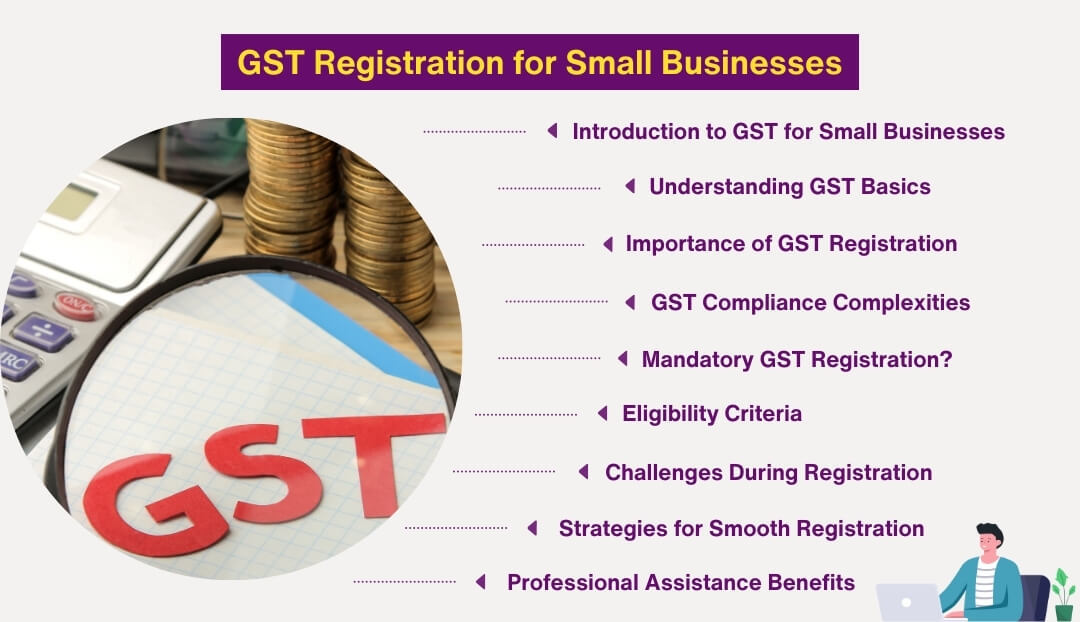
Sneha runs a home bakery in Pune. Orders were picking up, a café wanted her brownies every week, and then the café manager asked, “Can you send a GST invoice?”
She froze. Did she need a number? Was she already breaking a rule? If that sounds familiar, you’re not alone. GST registration for small business confuses almost everyone at first, mostly because the rules depend on what you sell and where. This guide covers who needs it, what to keep ready and how the process works on the portal.
Do You Actually Need GST Registration?
Is GST registration mandatory for small businesses? It depends on turnover and activity. In most states, the limits are ₹40 lakh for goods and ₹20 lakh for services. Registration is also mandatory in some cases regardless of turnover, such as when you sell through e-commerce platforms. incorpx
Special category states have lower limits. Goods traders face ₹20 lakh there instead of ₹40 lakh. google
Here’s where people get caught. Selling on Amazon or Flipkart typically requires a GSTIN, and so can serving clients across state lines. One example I came across: a consultant earning ₹15 lakh, under the service limit, but with clients in several states, may still have to register. Check your exact situation with a CA before assuming you’re exempt. citizennest
Voluntary Registration: Worth It Below the Limit?
You can register even if you’re under the threshold. Voluntary registration is open to any business below the limit. aiaccountant
Why would you? Input tax credit, for one. You can claim GST paid on purchases, which helps if you buy a lot of raw material. It also makes bigger clients take you more seriously. Many companies and government buyers simply prefer GST-registered vendors.
The catch: once you register, you must follow every filing requirement. That means monthly or quarterly returns, even in months with no sales. If you hate paperwork, think hard before opting in. incorpx
Documents Required for GST Registration
Keep these ready first. Most delays start here.
Every applicant needs the business PAN, a photo of the authorised signatory, business address proof and bank account details, and other papers depend on your business type. accountune
For a typical sole proprietor, that looks like:
- PAN and Aadhaar of the owner
- A passport-size photo
- Address proof: electricity bill, rent agreement, or an NOC from the owner if the space is rented or shared
- Bank account proof (cancelled cheque or statement)
Partnerships need a partnership deed. Companies need incorporation papers and a digital signature.
One thing worth repeating: utility bills should be recent, ideally within two or three months, since blurry scans and old bills get applications flagged as often as missing ones. Also, files are usually expected in JPG or PDF under 100 KB. Compress them before you start. accountunetaxguru
How to Apply: The Step-by-Step Portal Process
How do I register for GST online? Go to gst.gov.in, choose New Registration, and fill in Part A with your PAN, mobile and email. Verify the OTPs, then complete Part B with business details and documents. Submit with Aadhaar authentication or a digital signature, and track the ARN.
Here’s the order in practice:
- Open the portal and start a New Registration.
- Enter PAN, mobile number and email. Verify both OTPs.
- You’ll get a temporary reference number (TRN). Use it to log back in.
- Fill the ten sections of the application and upload your documents.
- Authenticate through Aadhaar OTP or sign digitally.
- Note your ARN and track the status.
- On approval, your GSTIN and certificate (Form REG-06) are issued electronically. taxaj
The registration itself costs nothing. No charges are levied to complete the process. Agents and CAs charge for their help, which is separate. bankbazaar
How Long Does It Take?
Shorter than most people fear. With Aadhaar OTP authentication, it typically takes around three working days, while skipping Aadhaar can stretch it from 7 to 30 days. citizennest
If an officer raises a question, reply quickly and attach a clear document. Silence is what turns a three-day job into a three-week one.
I’ve seen small sellers lose a full month because the bill name didn’t match the business name. Check that detail before submitting, not after a rejection notice.
Composition Scheme and Rule 14A: Two Options for Smaller Sellers
You have lighter options than the standard route. Under the GST registration for small business category, two are worth knowing.
The composition scheme caps turnover at a certain level and uses a flat tax. The cap is ₹1.5 crore, with a flat tax of 1-6% and restricted features. The trade-off is that you generally can’t claim input tax credit or charge GST separately to customers. richify
Then there’s Rule 14A. Small businesses with expected monthly output tax liability up to ₹2.5 lakh can opt for this simplified registration. It’s designed for quicker approval. bankbazaar
Newer changes are coming too. Reforms expected from November 1, 2026 include simpler registration for small e-commerce sellers working across several states. Rules shift, so confirm what’s live on the portal when you apply. indiatvnews
Mistakes That Slow Down Small Businesses
- Using a rented address without an NOC
- Names that don’t match across PAN, bank and bills
- Picking the wrong business category
- Ignoring returns after registration. Late fees pile up quietly.
- Registering and then forgetting to put the GSTIN on invoices
[Link to related guide on how to create a GST invoice here]
[Link to related article on GST return filing for beginners here]
[Link to related post on selling on Amazon India with GST here]
FAQs About GST Registration for Small Business
Is GST registration free?
Yes, the government portal doesn’t charge. Professional help costs extra.
Can I get GST with a home address?
Yes. Use a recent utility bill, plus an NOC if the home isn’t in your name.
What if my turnover is below ₹20 lakh?
You may not need it, but e-commerce selling or certain interstate work can still require registration. Check with a CA.
Can I sell on Amazon without GST?
Generally no. Most sellers need a GSTIN, though a few exempt categories exist.
What happens if I don’t register when required?
You may face penalties and back-tax demands. Don’t wait for a notice.
Conclusion
To sum up: check your turnover and sales channel, gather clean documents, apply on the GST portal with Aadhaar authentication, and follow up on the ARN. Look at composition or Rule 14A if filing worries you. That’s the whole route to GST registration for small business.
Sneha got her GSTIN in under a week and added it to her next invoice. The café manager never mentioned it again.
This week, pull out your last three bills and bank proof, then check they match your business name. Once that’s done, you’re half registered already.
Suggested image alt text:
- “Small business owner filling GST registration for small business on the GST portal”
- “Checklist of documents required for GST registration in India”
- “GST certificate and GSTIN printed on a business invoice”